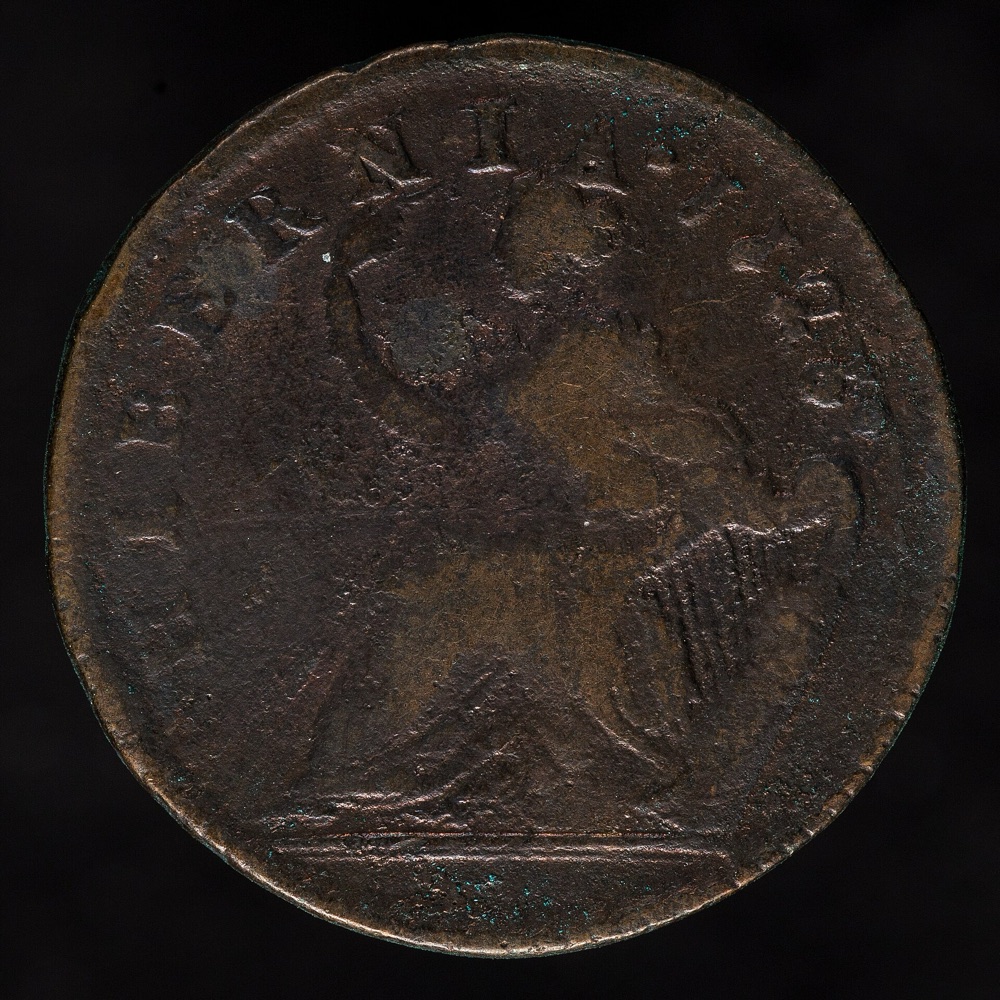
1723 Wood's Hibernia Halfpenny
- Maker
- William Wood (under royal patent, for Ireland/colonies)
- Year
- 1723
- Rank
- 54 of 100
1723 Wood's Hibernia Halfpenny
1723 Wood's Hibernia Halfpenny by William Wood (under royal patent, for Ireland/colonies) (1723) is ranked 54 in the FLOAT 100 for Coins. It carried a price-guide value of $4,000, which is not a sale. The notorious Wood's patent coinage that provoked Swift's 'Drapier's Letters'; widely collected as colonial American money.
What is it, and why is it in the FLOAT 100?
The notorious Wood's patent coinage that provoked Swift's 'Drapier's Letters'; widely collected as colonial American money.
1/2d copper, Hibernia, Martin variety, PCGS MS63-65 Brown/Red Brown
What is the best-sourced number for it?
- Figure
- $4,000
- Kind
- Price-guide value, not a sale
1723 Wood's Hibernia halfpenny in choice Mint State (MS63-65) carries a low-four-figure guide value; readily collected colonial type. Approximate representative Mint State figure per Greysheet.
This is not a sale. It is what the market was asking, and no transaction is recorded behind it. Source.
How this is made
- The figure
- One reference price, taken from a named public source and shown with its own kind. FLOAT does not average it with anything or adjust it for time.
- Realized or not
- A realized price is a completed sale. A market asking price and a price-guide value are not sales, and are labeled as such wherever they appear.
- Why no grade ladder
- Most FLOAT 100 entries are individual objects. There is one of this, so there is no population and no spread across grades to show.
- Archive
- 2026-08-08