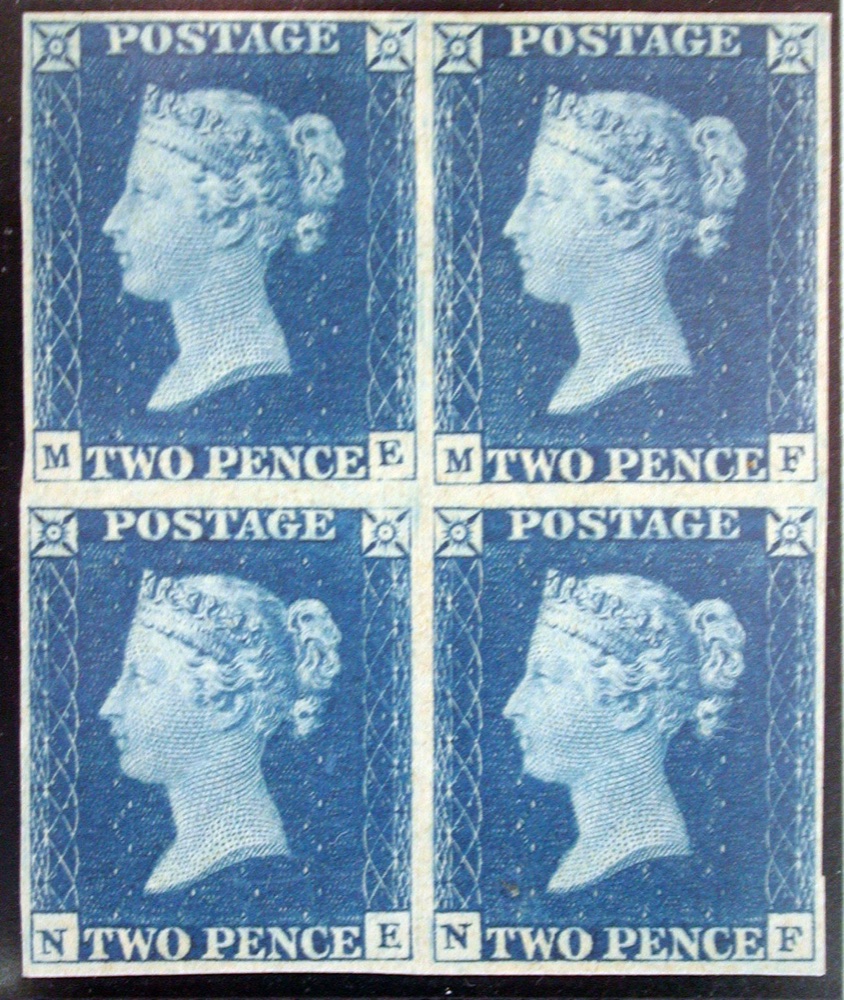
Two Penny Blue
- Maker
- Great Britain (Royal Mail)
- Year
- 1840
- Rank
- 7 of 100
Two Penny Blue
Two Penny Blue by Great Britain (Royal Mail) (1840) is ranked 7 in the FLOAT 100 for Stamps. It carried a price-guide value of $48,700 on 1 January 2026, which is not a sale. The companion to the Penny Black and the world's second adhesive stamp — markedly rarer, especially in sound four-margin condition.
What is it, and why is it in the FLOAT 100?
The companion to the Penny Black and the world's second adhesive stamp — markedly rarer, especially in sound four-margin condition.
2d blue, Queen Victoria, imperforate, no white lines (first state), SG 5; very fine unused with large part o.g.
What is the best-sourced number for it?
- Figure
- $48,700
- Kind
- Price-guide value, not a sale
- Date
- 1 January 2026
Stanley Gibbons catalogue ~GBP 38,000 (~$48,700) for a very fine unused SG 5; used examples catalogue ~GBP 1,000-2,750. Guide-value per honesty rule (no single isolated 2024-2026 realized figure).
This is not a sale. It is what the market was asking, and no transaction is recorded behind it. Source.
How this is made
- The figure
- One reference price, taken from a named public source and shown with its own kind. FLOAT does not average it with anything or adjust it for time.
- Realized or not
- A realized price is a completed sale. A market asking price and a price-guide value are not sales, and are labeled as such wherever they appear.
- Why no grade ladder
- Most FLOAT 100 entries are individual objects. There is one of this, so there is no population and no spread across grades to show.
- Archive
- 2026-08-08